




If you live in an apartment, the chance of birds settling on your balcony is high. Pigeons especially treat any flat surface above ground level as prime real estate – sheltered, predator-free and convenient. They leave droppings on chairs and railings, build nests behind air-conditioning units, and once a pair has bred there, the same family returns every spring. The good news is that balcony bird control is one of the simplest scenarios to solve permanently. Unlike a large garden or commercial roof, you are dealing with a small, defined space where the right balcony bird deterrent stops the problem within days. Here are the seven approaches that actually work, in the order most apartment dwellers should try them.
Why Pigeons (and Other Birds) Love Balconies
Three things attract birds to a balcony: shelter from wind and rain, height (which they associate with cliff-style nesting), and zero predators. Once a pigeon pair has scouted the space and decided it is safe, they will start nesting within days – typically behind air-conditioning units, on top of awnings, in the corner of a railing or tucked under flowerpots. If you spot the first feather or droppings, act immediately. Removing a fresh visit is far easier than evicting an established nest.
1. Stainless Steel Bird Spikes on Railings and Ledges
The single most effective permanent solution for a balcony is stainless steel bird spikes installed along the top railing, the air-conditioning unit cover, the awning frame and any ledge wide enough for a pigeon to land on. Marine-grade stainless lasts more than ten years even in salt-air coastal apartments. Spikes do not harm the bird – they simply make landing impossible – and once they are installed, the pigeon problem is solved permanently with zero ongoing maintenance. Use the standard pigeon-spec spikes for most species, wider variants if you have gulls.
2. Anti-Bird Netting Across the Balcony Front
For balconies that are open to the sky and large enough that birds can fly straight in, fine-mesh anti-bird netting tensioned across the front opening is the gold-standard solution. UV-stabilised netting (12-25 mm mesh) is virtually invisible from a distance and lasts a decade. It is especially common in southern European cities where pigeon colonies are dense. The netting permits airflow and a clear view, but birds simply cannot enter. This is the only method that produces 100 % exclusion without ongoing effort.
3. Reflective Tape and Mylar Streamers
Cheap, fast and surprisingly effective for a small balcony. Hang lengths of holographic mylar tape (€5-10 a roll) from the railing – the wind makes them flash unpredictably and pigeons quickly avoid the area. Replace every two months as the foil weathers. Reflective tape is not a permanent solution on its own, but it is the best emergency response if you spot the first signs of a pigeon visit and want to discourage them before they establish.
4. Compact Anti-Perching Spinners
The smaller residential versions of the Daddi Long Legs anti-perching spinner work well on apartment balconies that face the sea or are bothered by gulls rather than pigeons. The flexible stainless arms rotate in the wind and sweep the surface, making safe landing impossible. One unit covers a circle of 1.2-4.5 metres in radius depending on size, which is enough for most balconies. No power required, no batteries, weatherproof for years.
5. Motion-Activated Ultrasonic Repeller With Light
For people who cannot install permanent fixtures (rented apartment, listed building, body-corporate restrictions), a battery-powered motion-activated ultrasonic repeller with LED flash placed on the balcony is the best removable option. It activates only when a bird approaches, startles them with a brief sound and light burst, and switches off again to save battery. Note: this works much better on small mammals (cats, rodents) than on pigeons, but combined with reflective tape and visual deterrents it can be effective for casual balcony bird visits.
6. Predator Decoys (With Movement)
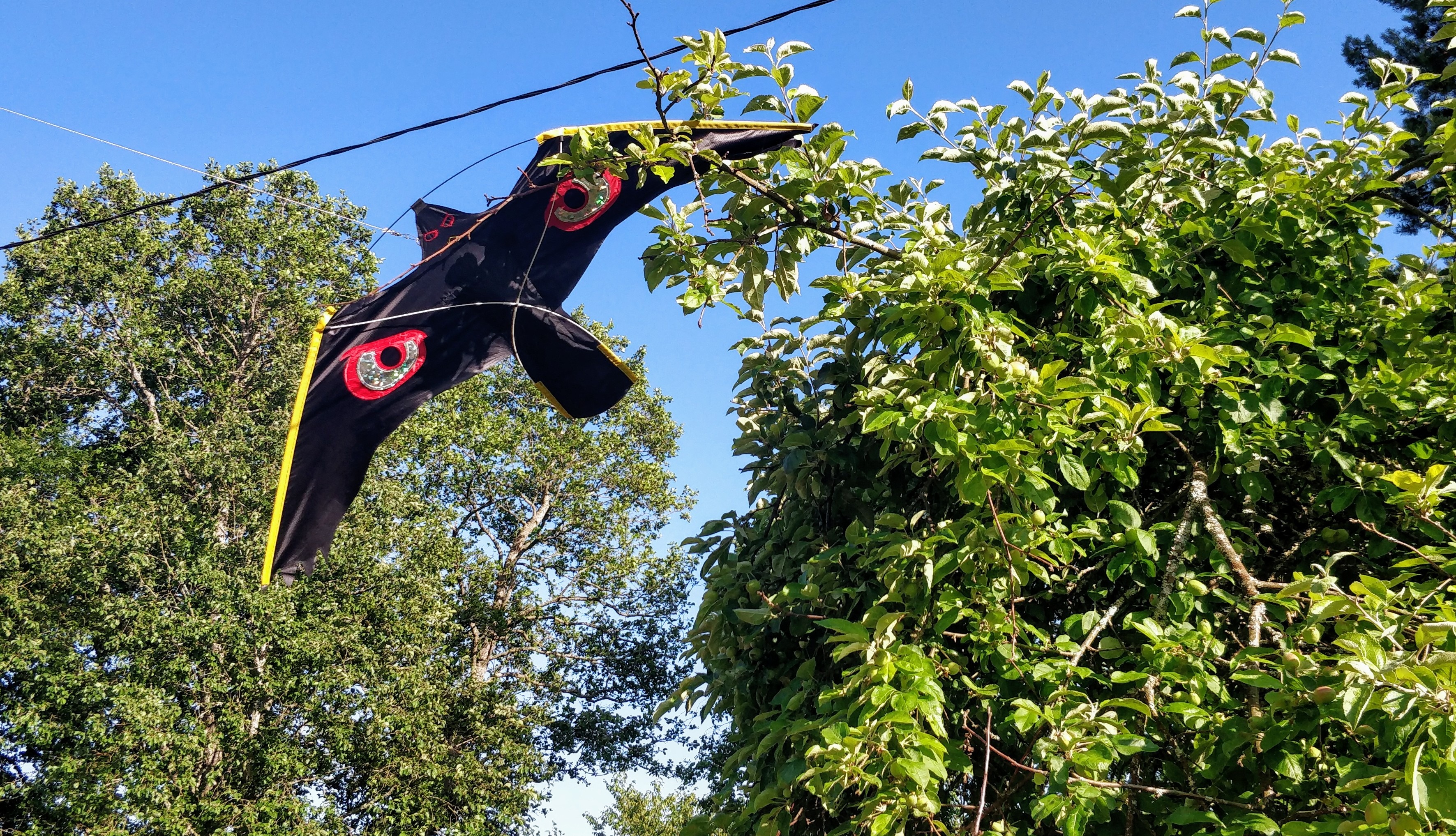
A small plastic owl or hawk silhouette on its own is identified as fake within 48 hours. But a lightweight feathered decoy mounted on a swivel base, relocated every two or three days, can keep its scaring power on a balcony for a full season. Combine with reflective tape and the result is genuinely effective on pigeons. The trick is the rotation – never leave a decoy in the same spot for more than three days.
7. Gel-Based Repellents on Ledges
Anti-perching gels applied in lines along ledges, window-sills and railings create a sticky, uncomfortable surface that birds avoid landing on. Modern gels are non-toxic and non-staining. They last 6-12 months outdoors before reapplication. Useful for narrow ledges where spikes would be visually intrusive – for example, decorative window sills on a heritage building. Not a stand-alone solution for a whole balcony, but a useful precision tool for specific perching spots.
Match the Deterrent to Your Balcony
- Small modern apartment balcony, casual visits: reflective tape and a motion-activated repeller, escalate to spikes if birds persist.
- City pigeon colony nearby: stainless steel spikes on every ledge plus full netting across the open front.
- Coastal balcony with gull problem: compact Daddi Long Legs spinner plus wider-spec spikes – see Seagull & Gull Control.
- Rented apartment, no permanent installations allowed: reflective tape, motion-activated repeller, removable predator decoy on rotation.
- Heritage or listed building: gel repellent on the actual perching points, plus removable visual deterrents.
- Established pigeon nest already present: remove the nest (legally – check local protections) and seal the area with spikes or netting before the pair returns.
Common Balcony Bird Mistakes
- Waiting until birds are already nesting – far harder to evict an established pair than to prevent the first visit. If you see a single feather or dropping, act that week.
- Buying a single static plastic owl – useless within two days.
- Relying on ultrasonic alone for pigeons – pigeons hear roughly the same frequency range as humans, so true ultrasonics have minimal effect on them. Audible deterrents and physical barriers work; ultrasonic gadgets alone do not.
- Ignoring food sources – if you keep feeding songbirds on the balcony, pigeons will join the buffet. Move feeders to a cage feeder that excludes larger species.
- Cleaning droppings without sealing the area – pigeons return to the same spot. Cleaning alone does not break the cycle; physical exclusion does.
Are Pigeons Protected? Legal Notes
Feral pigeons receive less protection than wild bird species in most of Europe, but rules vary by country and city. In the UK, you can legally deter and exclude feral pigeons but you cannot kill them outside specific licences. Across the EU, the same general principle applies. The methods on this page are all humane, non-lethal and legal everywhere – they make the balcony unsuitable, prompting the birds to relocate without harm. If you find an active nest with eggs or chicks, check local rules before disturbing it.
Get Your Balcony Back
The right balcony bird deterrent depends on whether you can install permanent fixtures and how serious the problem already is. For most apartment dwellers, the simple combination of stainless-steel spikes on the railing plus reflective tape on the front edge solves the problem within days and keeps it solved for a decade. Browse our Pigeon Control range and the broader Bird Busters product catalogue to find the spikes, netting and accessories sized for your balcony.
Frequently Asked Questions
How do I keep pigeons off my balcony permanently?
The single most effective permanent solution is stainless-steel bird spikes installed along every railing, ledge and air-conditioning unit cover. Spikes do not harm the bird – they simply make landing impossible – and once installed, they last more than ten years with zero ongoing maintenance. For balconies open to the sky, fine-mesh anti-bird netting tensioned across the front opening completes the exclusion. This combination produces 100 % permanent results.
What is the best balcony bird deterrent?
Stainless-steel bird spikes are the most effective permanent option for railings and ledges. For balconies in heavy pigeon-colony areas, full anti-bird netting across the open front is the gold-standard solution. For renters who cannot install permanent fixtures, a motion-activated ultrasonic repeller combined with reflective mylar tape and a rotating predator decoy is the best removable approach. Coastal balconies bothered by gulls benefit most from a compact Daddi Long Legs spinner.
Are pigeons protected by law?
Feral pigeons receive less protection than wild bird species in most of Europe, but rules vary by country. In the UK and across the EU you can legally deter and exclude feral pigeons but you cannot kill them outside specific licences. Every method on this page is humane, non-lethal and legal everywhere – they make the balcony unsuitable so the birds relocate without harm. If you find an active nest with eggs or chicks, check local rules before disturbing it.
Do ultrasonic bird repellents work on pigeons?
Not very well on their own. Pigeons hear roughly the same frequency range as humans, which means truly ultrasonic frequencies have minimal effect on them. Motion-activated devices that combine ultrasonic with a flashing LED light are more effective because the visual element matters more than the sound. For genuine permanent results on a balcony, physical barriers (spikes, netting) work much better than any ultrasonic gadget.
How do I scare birds off a rented balcony without permanent installations?
Use removable deterrents only. The best combination for renters is reflective mylar tape draped along the railing, a motion-activated ultrasonic repeller with light flash, and a small rotating predator decoy moved every two or three days. Add gel-based repellent on the actual perching points (it peels off cleanly when you move out). Together these methods discourage casual visits without modifying the property.
How quickly does a balcony bird deterrent work?
If the birds are casual visitors who have not yet started nesting, deterrents work within days – usually within the first week. If pigeons have already established a nest, allow two to three weeks for full displacement after sealing the area with spikes or netting. The earlier you act, the easier it is. If you spot the first feather or droppings, install deterrents that week – preventing the first visit is far easier than evicting an established pair.